Upcycling industrial marine byproducts in Patagonia into high-purity organic compound and sustainable bioactive metabolites.
Supported by an acceleration framework engineered to de-risk bioprocess scale-up in Patagonia.

AquaBiotics Sur is accelerated under the Volcanes Program, an initiative managed by Këtrawa Lab in conjunction with the UC Innovation Center, and funded by CORFO through its "Potencia" program. Within this incubation framework, we are actively structuring the strategic outreach to secure our first Letters of Intent (LOIs) for process stream supply with regional processing plants.
In Los Lagos, the sea is not just a landscape. It is a living industry. Each year, hundreds of thousands of tons of Chilean mussel are processed in coastal plants that generate, as an inevitable consequence, millions of liters of cooking broth.
That broth was treated for decades as a liability. A problem. A rising regulatory cost.
AquaBiotics Sur was born from a different question: what if that byproduct were, in reality, the most valuable raw material Chile has to offer to the world?
The Chilean mussel industry produces vast volumes of cooking liquid waste. These effluents, highly concentrated in organic nitrogen and phosphorus, are dumped directly into Patagonian waters, threatening fragile coastal marine biodiversity.
"We are not a remediation company.
We are a company that found value where no one was looking."
Target compound transfers massively to cooking water during thermal processing of mussels. The process stream is not a liability — it is a repository.
Pérdidas documentadas: hasta 100% de compuesto en el caudal
The first Chilean public project demonstrates that the MF→UF→NF route recovers compound from canning process water. The science was already funded by the State.
Retención NF: ~65% · Secuencia MF→UF→NF validada
At pilot scale in Galicia, nanofiltration achieves a concentration factor of 5.2× from mussel cooking water. Industrial technology exists.
Factor concentración: 5.2× · Eliminación DQO: 98.2%
Applying that knowledge to the specific broth of mytilus chilensis in Los Lagos, for the global premium petfood and nutraceutical market. The gap has not been closed.
Chilean regulations DS N °90 and Resolution 613 Exenta force mussel plants to manage process waters at rising costs. Every liter discharged has a regulatory price.
The high-value pet food segment grows over 6% annually and demands marine-origin, traceable, petroleum-free ingredients. Synthetic compound cannot meet this demand.
Nanofiltration membrane costs have dropped significantly. Processes that were economically unviable five years ago now yield positive margins.
Chile is the second largest mussel producer in the world. The raw material is available, continuous, and currently discharged without valuation. It cannot be replicated anywhere else.
Comparing petrochemical synthetic alternatives against AquaBiotics Sur closed-loop organic extract.
(Current Standard)
(Microalgae)
(Blue Extract)
Today, mussel cooking broth is a cost: treatment, disposal, risk of fines. AquaBiotics Sur transforms it into the raw material of a premium ingredient, with zero investment on your part.
Synthetic compound cannot be certified as organic. AquaBiotics Sur provides marine-origin, batch-traceable organic compound certified from Chiloé—the sole attribute that unlocks the premium segment that your competitors cannot reach.
Certified Upcycled & Clean Label energy drinks seeking to replace synthetic ingredients with sustainable, marine-derived alternatives.
Feline nutrition (essential nutrient). Premium natural pet food brands seeking non-synthetic additives.
Sustainable nutrition. Replacement of fishmeal with functional plant-based feeds supplemented with organic compound.
High-purity organic compound for human heart health and athletic performance supplements.
Our proprietary separation technology recovers biomolecules without chemicals, yielding clean-label, marine-origin ingredients.
Multistage filtration and clarification of the broth matrix.
Membrane filtration to retain macromolecules and concentrate target metabolites.
Proprietary chromatographic polishing to isolate 99%+ pure compound.
Final formulation into a stable, dry ingredient.
Integration into functional foods and nutraceuticals.
Structural exploration of marine metabolites and predictive AI engines for autonomous biorefinery control—presented as two complementary technical modules.
3D exploration of target metabolites, receptors, and enzymatic complexes via 3Dmol.js.
Structural parameters verified against primary chemical databases (PubChem / RCSB PDB).
Every technical claim on this site traces to an open primary source. Where the literature disagrees, we show the dispersion instead of averaging it. The full corpus is available on request.
Recovering savory compounds from mussel cooking water by filtration and diafiltration
Cadena, E.; Dewulf, J.; San Martin, D.; Ibarruri, J.; Iñarra, B.; Gutierrez, M. · Membranes (MDPI), 2025, 15(8):242
Third-party European pilot: 98.2% COD removal, amino acids concentrated 5.2×
An environmental management industrial solution for the treatment and reuse of mussel wastewaters
Prieto, M.A.; Prieto, I.; Vázquez, J.A.; Ferreira, I.C.F.R. · Science of the Total Environment, 2015, 538:117–128
DOI 10.1016/j.scitotenv.2015.07.041 · PMID 26298254
Recovery of savory compounds from mussel cooking side stream as a circular economy solution
Future Foods, 2024 · ScienceDirect S2667010024000064
Cooking accounts for 80% of the organic load of the final discharge
Wastewater treatment in the fishery industry
FAO Fisheries Technical Paper 355, 1996 — §2, Table 2.2
Characterisation of process streams across the fish and shellfish industry
The separation train is designed from the outset to be instrumented. This is the architecture we intend to build, described as such.
Four architectures that couple spectroscopy, reinforcement learning, computer vision and digital-twin simulation to the membrane cascade. None is deployed today: there is no plant, no PLC and no trained model. The performance figures cited are target values reported in the literature for analogous industrial systems, not results obtained by AquaBiotics Sur. Building them is a milestone of the scale-up phase, not of the current stage.
Planned: XGBoost and 1D CNN models over NIR spectroscopy, to estimate metabolite concentration in line and reduce dependence on offline HPLC. Literature on analogous systems reports sub-60-second inference and up to 70% fewer HPLC runs. Requires a trained model and a spectrometer on the line — neither exists today.
Planned: LSTM fouling predictors and Proximal Policy Optimization control, designed for OPC-UA integration with industrial PLCs. Literature on analogous systems reports net permeate flux gains near 15% and multi-hour fouling forecasts. Requires an instrumented pilot plant with operating history — the pilot is not built.
Planned: computer vision for microscopic density monitoring and Bayesian optimization for experimental design. Literature on analogous systems reports substantial reductions in the number of runs required to converge. Applies from the bench-scale campaign onward.
Planned: a hybrid physico-chemical and data-driven simulation of the train, to optimise scheduling against processing-plant shutdowns and to solve collection routing across multiple plants. Its value grows with the number of supply agreements — today there are none signed.
Why we describe this now, before building it: the separation behaviour of this matrix is not deducible from a datasheet, so the operating data generated during scale-up is itself an asset. Designing the instrumentation before the plant exists is what makes that data usable — and what keeps the model, once trained, inside the company as a trade secret.
Quantifying our progress across technology execution, business planning, and market validation.
Scientific hypothesis validated. Laboratory testing confirms selective recovery of organic compound from cooking water under static test matrices.
Initial market analysis complete. Customer validation launched to gather requirements from pet food and aquaculture feed manufacturers.
Initial financial modeling designed. Strategic roadmap established. Applying for seed grants and local incubation programs.
Our technology roadmap follows a layered protection model (Onion IP) designed to shield both physical assets and digital developments before industrial scale-up.
Invention patents protecting the modular biorefinery sequence and stable composition profiles of marine biocompounds (Blue Taurine, Prebiotics and Prebiotic Protein Extract).
Hybrid protection for industrial process control predictors: Computer-Implemented Invention (CII) patents for algorithms with physical plant impact, and trade secret (know-how) under strict governance for quality prediction models.
International trademark registration and Geographic Indication (G.I.) structuring that exclusively links the biotechnological value of the extract to the terroir of the Los Lagos Region fjords.
Mussel Cooking Broth (mussel process stream)
Blue Extract (Organic Marine Compound)
>95% HPLC Purity · Clean Label · Upcycled
Every statement on this site has a verified source. These are the references that sustain the technical viability of AquaBiotics Sur.
AMIChile / Diario Chiloé (2024)
Dragnes et al. (2009). Int. Journal of Food Sciences and Nutrition, 60(2), 143-152.
Pérez-Santaescolástica et al. (2024). Future Foods.
Bjerknes et al. (2024). Frontiers in Nutrition, 11:1443229.
Verified Market Reports (2024). Market — Global Industry Analysis.
Operating at the intersection of the marine industry and biotechnology.
Regenerative Model
• Target 12.5: Substantially reduce waste generation through upcycling industrial streams.
AquaBiotics: We transform thousands of tons of mussel cooking effluents, turning waste into high-value bioactives.
• Target 12.4: Environmentally sound management of wastes throughout their life cycle.
AquaBiotics: Our chemical-free extraction cleanly treats effluents before returning them to the ecosystem.
Ocean Conservation
• Target 14.1: Prevent and significantly reduce marine nutrient pollution from land-based activities.
AquaBiotics: By removing up to 98% of the organic load, we directly prevent coastal eutrophication.
• Target 14.2: Sustainably manage and protect marine and coastal ecosystems.
AquaBiotics: We protect Patagonia's fragile marine biodiversity against harmful industrial dumping.
Sustainable Water Management
• Target 6.3: Improve water quality by reducing pollution and halving untreated process water.
AquaBiotics: Our biorefinery purifies industrial water streams, drastically reducing untreated discharges.
Fostering Resilient Ecosystems
• Target 9.4: Retrofit industries with clean technologies and increased resource-use efficiency.
AquaBiotics: We provide the local industry with scalable, green technology to modernize their operations.
• Target 9.5: Enhance scientific research and upgrade technological capabilities.
AquaBiotics: Our AI-driven bioinformatics and molecular separation bring DeepTech to the region.
Combating Climate Change
• Target 13.2: Integrate low-carbon bio-extraction measures into operational strategies.
AquaBiotics: Our energy-efficient extraction processes have a much lower carbon footprint than synthetic alternatives.
Sustainable Growth
• Target 8.2: Higher economic productivity through technological upgrading.
AquaBiotics: We create high-value IP and tech-driven jobs in a traditionally extraction-based economy.
• Target 8.4: Improve resource efficiency, decoupling growth from degradation.
AquaBiotics: We enable economic growth through circular upcycling without environmental deterioration.
AquaBiotics Sur was born in the heart of the Los Lagos Region in southern Chile, a territory known for its pristine fjords and thriving aquaculture industry. A paradox was recognized: while the mussel industry is a major economic driver, it also generates significant volumes of liquid byproduct that is currently discarded.
this was seen not as a liability, but as an untapped reservoir of valuable marine biomolecules. The mission is to lead the Blue bioeconomy through marine biotechnology.
To lead the Blue bioeconomy by sanitizing the coasts, replacing synthetics with sustainable purity, and positioning Patagonia as a global hub for biotech innovation.
To be the global leader in upcycled marine metabolites, setting the standard for circularity and biotech excellence from the heart of Patagonia.
Strategic operations in Los Lagos Region, Chile—the hub of the Chilean mussel industry.
99% of Chile's mussel cultivation is concentrated in the pristine fjords of the Los Lagos Region. Our bioactives are not synthesized in abstract chemical plants; they are traceable to specific coordinates in Patagonia, safeguarding natural ecosystems.

Founder & CEO | Biotechnology Engineer
Specialized in molecular biotechnology and biological wastewater treatment. Architect of the project's separation train, molecular map, tecno-economic model, FTO analysis, and primary source audits.
At AquaBiotics Sur, he leads process scaling and technology validation, replacing petro-synthetics with clean-label ingredients harvested from Patagonia's marine currents.
"We didn't set out to build a treatment plant; we discovered high-value molecules where everyone else saw process water."
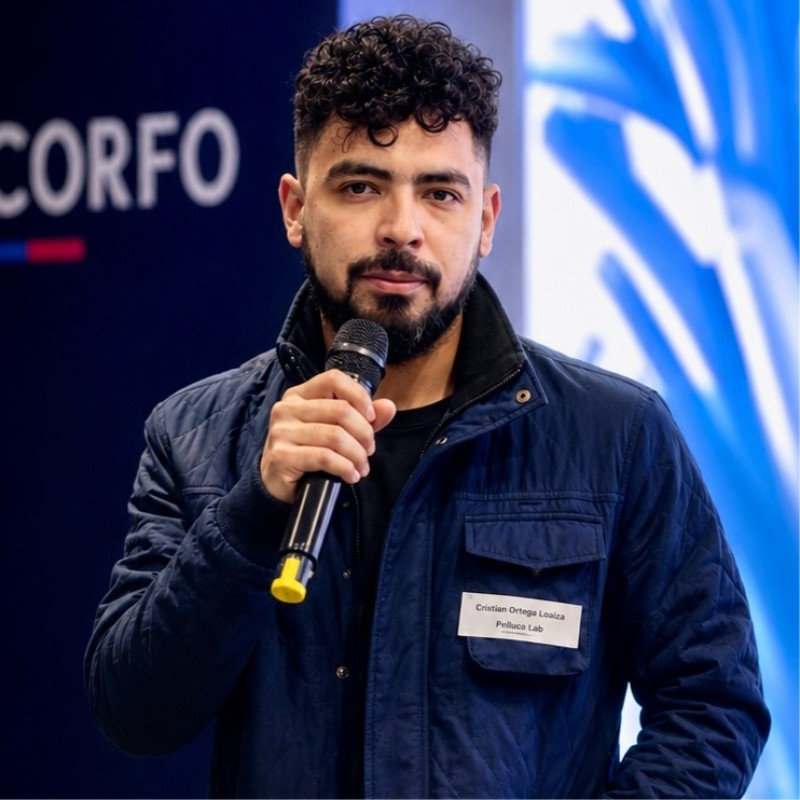
Co-Founder & COO | Marine Biotechnology & Aquaculture Engineer
Engineer in Marine Biotechnology and Aquaculture with extensive direct experience supervising processes and operations across Patagonia's primary salmon industry. Leads territorial operations, processing plant engagement, and raw stream collection logistics.
"Having managed live operations and supervised processing in Patagonia's salmon industry, I experienced the reality firsthand. True sustainability means transforming aquaculture from the inside out to generate a lasting positive impact."
We are constructing the first modular biorefinery pilot in Patagonia. Get in touch to discuss seed investment, product sampling, or aquaculture raw-material alliances.